Most time I am thinking in euroes now but when I buy something I am doing an X 70 in my head. I know the seven times table so well now. As I was trying to buy a ticket in Amsterdam, I paid with my international debit card for a normal 7 euro day ticket and then later next night as I checked my Indian account, a figure of 508rs. caught my eye. BAM . I was hit by the rupee syndrome! 500rs for Public transport? aaaaa.
Beware of this syndrome in your travels abroad. Many a good thing I walked away from becoz I would multiply it by 70 and decide that it's not worth paying so much. We are getting paid in euroes here ( Thank God and S's exchange fellowship !) but then every now and then I do a X71 and gasp at what I am paying for stuff. ( all are today's exchange rate of 71euroes to a rupee!)
these are from cents in euroes to rupees:
46rs for a flavoured milk of 250ml
35rs for a packet of bread
35-40rs for garbage bags
106rs to wash my clothes in the washing machine and if I use the drier, another 106!
Rice is relatively cheap at 70rs for a kg!
All the economics really confused me so till now I kept euro accounts. As the days to go home come closer, I am busy picking up small gifts for my friends and family. Small light and cheap, but also to their liking. Choosing gifts is fun and I feel quite the santa claus. And again,
I am back to the ruppee syndrome and voila, I discover, everything is cheaper at home!
Purses, clothes, pens , pencils, even notebooks are cheaper rupee to euro! For the same kind stuff I pay more here. Certainly don't come to shop in europe. Just get your cheese olives and chocolates, they are good and we don't get them back in India. Instead pack your head with sights, sounds, smells and the memories of this place. They are priceless! Here a few more from inside my head captured in the camera.
Showing posts with label Berlin. Show all posts
Showing posts with label Berlin. Show all posts
Friday, December 04, 2009


 inside of a metroUbahn station

Saturday, November 21, 2009
Older Potsdam and a bit of Hearsay History
The older half history of potsdam is about wars ,potatoes and royal eccentricities. At the center of all this is the Prussian crown first worn by the "King in Prussia" Fedrick I and then consequently Fedrick II then The Nephew and so on...

Suum cuique ("to each, his own"), the motto of the Order of the Black Eagle created by King Frederick I in 1701, was often associated with the whole of Prussia. I like the motto, Its sounds like a NIAS doctoral program motto to me! ( specially in our 'Multi-disciplinary' fields) And hey notice the eagle similarities to our logo at NIAS? Heh Heh.
Here are two nice examples of the eagle.

The Hohenzollern state was then known as Brandenburg-Prussia, belonging to family called Electors.The Margraviate of Brandenburg within the Holy Roman Empire and the Duchy of Prussia outside of the Empire.(This was not a Kingdom as kingdoms within the holy roman empire were not allowed.) It was Frederick I who convinced the then Leopold I, Archduke of Austria and Holy Roman Emperor, was to allow Prussia to be ruled as a kingdom. He called himself "KING IN PRUSSIA," so as not to threaten territories of the hohenzollern that were not in Prussia. Berlin was called Königsberg!

The Blue ladies in the background holding the crown on the New palace are the three graces.They ordinarily numbered three, from youngest to oldest: Aglaea ("Beauty"), Euphrosyne ("Mirth"), and Thalia ("Good Cheer"). In Roman mythology they were known as the "Graces." Sometimes a joke was that in this palace they were the three queens around Frederick , including Empress Elizabeth. ( wait For this Story later in the blog)
His son called Frederick II (the great) had a traumatic childhood and youth. At age 16, Frederick II had formed an attachment to the king's 13-year-old page, Peter Karl Christoph Keith. Wilhelmina ( his older sister) recorded that the two "soon became inseparable. In a strange turn of political events the young prince tried to run away from his autocratic father to England, was caught and punished. The saddest part is that the king forced Frederick to watch the decapitation of his confidant Katte at Küstrin on 6 November, leaving the crown prince to faint away and suffer hallucinations for the following two days.
Taking on the Kingdom after his father's death,Frederick managed to transform Prussia from a European backwater to an economically strong and politically reformed state. His acquisition of Silesia during the silesian war provided economic benefits. Canals were built, including between the Vistula and the Oder, swamps were drained for agricultural cultivation, and new crops, such as the potato and the turnip, were introduced. The potato story is worth retelling.
So the people hate eating things that grow below the ground. "Food For hogs! ( pigs)" they insisted. Food shortage was affecting the people of Prussia who had to learn to eat this nice round kartoffels. Despite education and awareness people tried to eat the green shoots of the potato and fell ill. So Fredrick devised a strategy. He had potatoes planted in the royal gardens and had it heavily guarded as special food for the royal kitchens. The curious citizens raided the gardens for the "special veggie." The guards (as planned by the king) looked the other way as the smuggled potatoes made their way into people's kitchens and cuisines.
The Flip side is that potatoes became so much important in europe that when the crop failed, it caused the potato famine that also affected germany. Apparently turnips saved the day reported my guide.
Forced in to marriage for political reasons, he never spent time with his wife who lived in a different palace. ( He called her a fat cow!!) He is often suspected to be homosexual, or struck with some ailment that made him stay away from women but the pages of history are blurred even about kings.
Frederick took no pleasure from his popularity with the common folk, preferring instead the company of his pet Italian greyhounds, whom he referred to as his 'marquises de Pompadour' as a jibe at Madame de Pompadour. His final resting place marker is near his beloved dogs as he had requested. ( not next to his wife) People put potatoes on his grave as a mark of respect which is in the beloved summer palace in south side facing the gardens at Potsdam.

The actual entombed body in its tomb was transported, protected in bunkers and then finally after WWII was laid to rest in in the Kaiser Friedrich Mausoleum in Sanssouci's Church of Peace on the grounds of the park for a while. The King 's body was then shifted again after reunification.

On 17 August 1991, Frederick's casket lay in state in the court of honor of Sanssouci, covered by a Prussian flag and escorted by a Bundeswehr guard of honour. After nightfall, Frederick's body was finally laid to rest on the terrace of the vineyard of Sanssouci, according to his last will without pomp and at night near his Italian Greyhounds.
It was befitting tribute to der alte Fritz ("Old Fritz"), he was fondly called , as both the nazis and the autocratic rule of had done much damage by using him for their propaganda.
The king preferred spending his time in his summer residence Potsdam, where he built the palace of Sanssouci, the most important work of Northern German rococo. Sanssouci, which translates from French as "carefree" or "without worry", was a refuge for Frederick.The most beautiful facade overlooks the beautiful gardens on the south side. You walk down the steps from this and you are in a steps like garden that is delightfully coloured. ( I am not sure but either all women were not allowed here or the queen was not allowed)
On a personal aside, the guide did have a very thick accent and for some time I kept thinking the king loved ducks ( "Doocks" he said) and he was buried next to his lovely ducks. ( there are ducks in the fountains). Kept wondering how in those days those ducks did not end up on his table? Then realized it was dogs when he said in reply to a question by some one that the Doocks were italian greyhounds!!!


 Front reception
 A windmill near the gate.
 Next to the palace
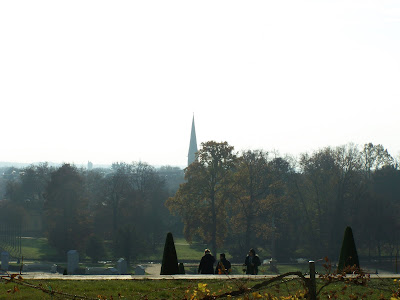


Situated on the western side of the Sanssouci royal park ( am Luste garten) The building was begun in 1763, after the end of the Seven Years' War, under Frederick the Great and was completed in 1769. It is considered to be the last great Prussian baroque palace.
 The New palace is on the same grounds, you can walk up.
The Seven years war : On 29 August 1756 his well-prepared army crossed the frontier and invaded Saxony, thus beginning the Seven Years' War (1756–1763). Facing a coalition which included Austria, France, Russia, Saxony, and Sweden, and having only Great Britain and Hanover as his allies, Frederick narrowly kept Prussia in the war despite having his territories frequently invaded.He was almost at the losing end of the war, the Prussian army was greatly weakened and had just lost the vital Baltic Sea port of Kolberg to the Russians when Emperess Elizabeth of Russia ( who was behind the Russian's assault) suddenly died ( at the beginning of 1762). It is called "Miracle of the House of Brandenburg," becoz it turned Frederick's defeat into a victory of sorts. Elizabeth's nephew came to the throne as Peter III. Peter was notoriously pro-Prussian; on his accession, he withdrew his troops and ended the war. In celebration getting into lots of debt Frederick the great built his new palace.

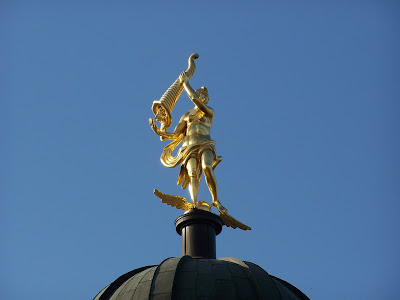
Ostentatiously, this is the Kitchen with Fortuna shining on a top!

 Prussia on the World?
 look carefully at the wall above and the picture below . Can you see which is original brick?

For the King, the New Palace was not a principal residence, but a display for the reception of important royals and dignitaries. Of the over 200 rooms, four principal gathering rooms and a theater were available for royal functions, balls and state occasions. I did not go IN! Maybe for another visit some other time!
During his occasional stays at the palace, Frederick occupied a suite of rooms at the southern end of the building, composed of two antechambers, a study, a concert room, a dining salon and a bedroom, among others.
Skipping a few other kings and their stories... Read your own history.
From King to emperor:
Just fast forwarding to another Era in German history, now.
Wilhelm I, also known as Wilhelm the Great[1] (William Frederick Louis, German: Wilhelm Friedrich Ludwig) (22 March 1797–9 March 1888) of the House of Hohenzollern was the King of Prussia (2 January 1861–9 March 1888) and the first German Emperor (18 January 1871–9 March 1888).During the Franco-Prussian War, on 18 January 1871 in Versailles Palace, Wilhelm was proclaimed German Emperor. The title "German Emperor" was carefully chosen by Bismarck after discussion until (and after) the day of the proclamation. Wilhelm accepted this title grudgingly as he would have preferred "Emperor of Germany."
Under the leadership of Wilhelm and his Chancellor Otto von Bismarck, Prussia achieved the unification of Germany and the establishment of the German Empire. Bismarck looks a bit like one of our friends.. Just try a guess game till I get back and tell you.

The Iron Chancellor", Bismarck held an important role in the German government and greatly influenced German and international politics both during and after his time of service.Bismarck's most important legacy is the unification of Germany. Germany had existed as a collection of hundreds of separate principalities and Free Cities since the formation of the Holy Roman Empire. Over the next thousand years various kings and rulers had tried to unify the German states without success until Bismarck. Largely as a result of Bismarck's efforts, the various German kingdoms were united into a single country. Following unification, Germany became one of the most powerful nations in Europe. Bismarck's astute, cautious, and pragmatic foreign policies allowed Germany to retain peacefully the powerful position into which he had brought it; maintaining amiable diplomacy with almost all European nations.
Unfortunately, is diplomatic feats were undone, however, by Kaiser Wilhelm II, whose policies unified other European powers against Germany in time for World War I.
THE ONLY MAN IN GERMANY:
She was a woman, whom Napoleon called the only man in Germany. Luise Auguste Wilhelmine Amalie (Luisa Augusta Wilhelmina Amelia) (10 March 1776 – 19 July 1810) was Queen consort of Prussia. called Q. Louise of Meckenburg, this iron hearted lady stood by her people. As Queen of Prussia, she commanded universal respect and affection, and nothing in Prussian history is more admired than the dignity and unflinching courage with which she bore the sufferings inflicted on her and her family during the war between Prussia and France. After the battle of Jena she went with her husband to Königsberg, and when the battles with France had placed Prussia absolutely at the mercy of France, she made a personal appeal to Napoleon I of France at his headquarters in Tilsit, but without success.
And so we stop here letting you savour these different buildings in Potsdam,
Some Dutch, some barracks, some Siberian, some tudor, some plain ols german. All hertitage buildingsd and the town itself is one big building musuem.
We enter through the Brandenburg tor, as Potsdam is the capital of Brandenburg.


Above are pictures of the siberian houses colony in Potsdam, a set of wooden houses. There were many Russian soldiers stationed here Totally classic!!
The Dutch were called to drain the marshy lands in Potsdam and encouraged to stay and enjoy trade. A dutch colony was created that later of course was occupied by local traders.


 ( Faintly the star, a political symbol on the lawn usually filled with blue flowers in spring, now its winter and so brown)
 houses with german rocco, restored and occupied.


Finally I think that's it about Potsdam.
The next blog is about LIFE in DDR ( east germany): common potty breaks in school and a plastic body car and a bit more on Bunkers after the second underground tour I took. Signing off from Berlin, your doctoral candidate friend in Berlin breaking out of her own walls, all wrapped up in wool... (PS.Gelathi, notice your nice gift's new use, it holds my mufflers in place)


You can buy this replica for 80 euroes at the shop!!! I thought that if I wore it it would be too heavy considering the Phd feather on cap is too long and heavy in its creation to be replaced by gold imitation!
Suum cuique ("to each, his own"), the motto of the Order of the Black Eagle created by King Frederick I in 1701, was often associated with the whole of Prussia. I like the motto, Its sounds like a NIAS doctoral program motto to me! ( specially in our 'Multi-disciplinary' fields) And hey notice the eagle similarities to our logo at NIAS? Heh Heh.
Here are two nice examples of the eagle.

The Hohenzollern state was then known as Brandenburg-Prussia, belonging to family called Electors.The Margraviate of Brandenburg within the Holy Roman Empire and the Duchy of Prussia outside of the Empire.(This was not a Kingdom as kingdoms within the holy roman empire were not allowed.) It was Frederick I who convinced the then Leopold I, Archduke of Austria and Holy Roman Emperor, was to allow Prussia to be ruled as a kingdom. He called himself "KING IN PRUSSIA," so as not to threaten territories of the hohenzollern that were not in Prussia. Berlin was called Königsberg!

His son called Frederick II (the great) had a traumatic childhood and youth. At age 16, Frederick II had formed an attachment to the king's 13-year-old page, Peter Karl Christoph Keith. Wilhelmina ( his older sister) recorded that the two "soon became inseparable. In a strange turn of political events the young prince tried to run away from his autocratic father to England, was caught and punished. The saddest part is that the king forced Frederick to watch the decapitation of his confidant Katte at Küstrin on 6 November, leaving the crown prince to faint away and suffer hallucinations for the following two days.
Taking on the Kingdom after his father's death,Frederick managed to transform Prussia from a European backwater to an economically strong and politically reformed state. His acquisition of Silesia during the silesian war provided economic benefits. Canals were built, including between the Vistula and the Oder, swamps were drained for agricultural cultivation, and new crops, such as the potato and the turnip, were introduced. The potato story is worth retelling.
So the people hate eating things that grow below the ground. "Food For hogs! ( pigs)" they insisted. Food shortage was affecting the people of Prussia who had to learn to eat this nice round kartoffels. Despite education and awareness people tried to eat the green shoots of the potato and fell ill. So Fredrick devised a strategy. He had potatoes planted in the royal gardens and had it heavily guarded as special food for the royal kitchens. The curious citizens raided the gardens for the "special veggie." The guards (as planned by the king) looked the other way as the smuggled potatoes made their way into people's kitchens and cuisines.
The Flip side is that potatoes became so much important in europe that when the crop failed, it caused the potato famine that also affected germany. Apparently turnips saved the day reported my guide.
Frederick also aspired to be a philosopher-king like the Roman emperor Marcus Aurelius. The king joined the Freemasons in 1738 and stood close to the French Enlightenment, admiring above all its greatest thinker, Voltaire, with whom he corresponded frequently. The personal friendship of Frederick and Voltaire came to an unpleasant end after Voltaire's visit to Berlin and Potsdam in 1750–1753, although they reconciled from afar in later years. ( Wikki Source)
Forced in to marriage for political reasons, he never spent time with his wife who lived in a different palace. ( He called her a fat cow!!) He is often suspected to be homosexual, or struck with some ailment that made him stay away from women but the pages of history are blurred even about kings.
Frederick took no pleasure from his popularity with the common folk, preferring instead the company of his pet Italian greyhounds, whom he referred to as his 'marquises de Pompadour' as a jibe at Madame de Pompadour. His final resting place marker is near his beloved dogs as he had requested. ( not next to his wife) People put potatoes on his grave as a mark of respect which is in the beloved summer palace in south side facing the gardens at Potsdam.


It was befitting tribute to der alte Fritz ("Old Fritz"), he was fondly called , as both the nazis and the autocratic rule of had done much damage by using him for their propaganda.
The king preferred spending his time in his summer residence Potsdam, where he built the palace of Sanssouci, the most important work of Northern German rococo. Sanssouci, which translates from French as "carefree" or "without worry", was a refuge for Frederick.The most beautiful facade overlooks the beautiful gardens on the south side. You walk down the steps from this and you are in a steps like garden that is delightfully coloured. ( I am not sure but either all women were not allowed here or the queen was not allowed)
On a personal aside, the guide did have a very thick accent and for some time I kept thinking the king loved ducks ( "Doocks" he said) and he was buried next to his lovely ducks. ( there are ducks in the fountains). Kept wondering how in those days those ducks did not end up on his table? Then realized it was dogs when he said in reply to a question by some one that the Doocks were italian greyhounds!!!


Entrance.
 Front reception
 A windmill near the gate.
 Next to the palace
 View from the top:
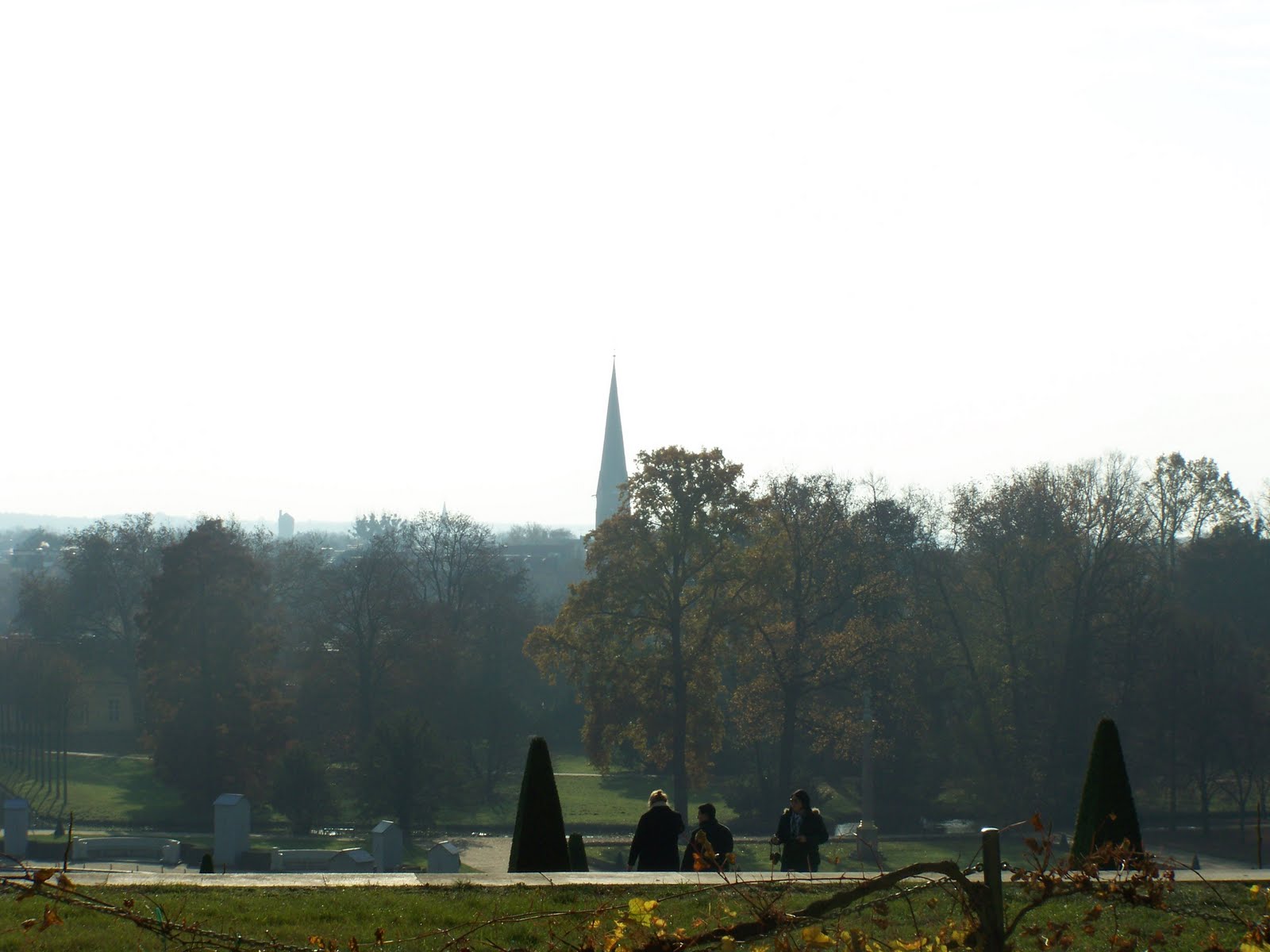
and what a surprise at the view from the lower tier. From the lower gardens the whole view of the grape vines is beautiful, even when the leaves are turning brown.

Rococo is a style of architecture and art that developed in France . If you want to know more about it, Click HERE for a wikki-link. You can see the German rococo style in these details (the white is sadly discolored)."Architects often draped their interiors in clouds of fluffy white stucco."

Situated on the western side of the Sanssouci royal park ( am Luste garten) The building was begun in 1763, after the end of the Seven Years' War, under Frederick the Great and was completed in 1769. It is considered to be the last great Prussian baroque palace.
 The New palace is on the same grounds, you can walk up.
The Seven years war : On 29 August 1756 his well-prepared army crossed the frontier and invaded Saxony, thus beginning the Seven Years' War (1756–1763). Facing a coalition which included Austria, France, Russia, Saxony, and Sweden, and having only Great Britain and Hanover as his allies, Frederick narrowly kept Prussia in the war despite having his territories frequently invaded.He was almost at the losing end of the war, the Prussian army was greatly weakened and had just lost the vital Baltic Sea port of Kolberg to the Russians when Emperess Elizabeth of Russia ( who was behind the Russian's assault) suddenly died ( at the beginning of 1762). It is called "Miracle of the House of Brandenburg," becoz it turned Frederick's defeat into a victory of sorts. Elizabeth's nephew came to the throne as Peter III. Peter was notoriously pro-Prussian; on his accession, he withdrew his troops and ended the war. In celebration getting into lots of debt Frederick the great built his new palace.


Next door is the servant's quarters ( being Restored) with Victoria.

We need fortune and Victory!
In an architectural form, Frederick the Great sought to demonstrate the power and glories of Prussia attributing it as fanfaronade, an excess of splendor in marble, stone and gilt. Alas he ran out of money and so his bed chamber has original brick and stone while the main palace is painted brickwork!
 Prussia on the World?
 look carefully at the wall above and the picture below . Can you see which is original brick?
During his occasional stays at the palace, Frederick occupied a suite of rooms at the southern end of the building, composed of two antechambers, a study, a concert room, a dining salon and a bedroom, among others.
Skipping a few other kings and their stories... Read your own history.
From King to emperor:
Just fast forwarding to another Era in German history, now.
Wilhelm I, also known as Wilhelm the Great[1] (William Frederick Louis, German: Wilhelm Friedrich Ludwig) (22 March 1797–9 March 1888) of the House of Hohenzollern was the King of Prussia (2 January 1861–9 March 1888) and the first German Emperor (18 January 1871–9 March 1888).During the Franco-Prussian War, on 18 January 1871 in Versailles Palace, Wilhelm was proclaimed German Emperor. The title "German Emperor" was carefully chosen by Bismarck after discussion until (and after) the day of the proclamation. Wilhelm accepted this title grudgingly as he would have preferred "Emperor of Germany."
Under the leadership of Wilhelm and his Chancellor Otto von Bismarck, Prussia achieved the unification of Germany and the establishment of the German Empire. Bismarck looks a bit like one of our friends.. Just try a guess game till I get back and tell you.

Unfortunately, is diplomatic feats were undone, however, by Kaiser Wilhelm II, whose policies unified other European powers against Germany in time for World War I.
THE ONLY MAN IN GERMANY:
She was a woman, whom Napoleon called the only man in Germany. Luise Auguste Wilhelmine Amalie (Luisa Augusta Wilhelmina Amelia) (10 March 1776 – 19 July 1810) was Queen consort of Prussia. called Q. Louise of Meckenburg, this iron hearted lady stood by her people. As Queen of Prussia, she commanded universal respect and affection, and nothing in Prussian history is more admired than the dignity and unflinching courage with which she bore the sufferings inflicted on her and her family during the war between Prussia and France. After the battle of Jena she went with her husband to Königsberg, and when the battles with France had placed Prussia absolutely at the mercy of France, she made a personal appeal to Napoleon I of France at his headquarters in Tilsit, but without success.
And so we stop here letting you savour these different buildings in Potsdam,
Some Dutch, some barracks, some Siberian, some tudor, some plain ols german. All hertitage buildingsd and the town itself is one big building musuem.
We enter through the Brandenburg tor, as Potsdam is the capital of Brandenburg.


Another interesting gate is this rocky cave entrance to the Nordic gardens at Sanssouci. Apparently if you are a liar, rocks will drop on your head here. ( politicians beware). Philosophers rest assured the gate is confused if you ask it- what is truth? See I stood for ages for this shot and not a dust dropped on my head. Social scientists may ask what is reality? instead. Scientists... Mmm I dont know just be careful. Politicians, dont dare come near anywhere. It may decide to throw rocks rather than drop them.


Above are pictures of the siberian houses colony in Potsdam, a set of wooden houses. There were many Russian soldiers stationed here Totally classic!!
The Dutch were called to drain the marshy lands in Potsdam and encouraged to stay and enjoy trade. A dutch colony was created that later of course was occupied by local traders.


a totally false egyptian needle a minaret style pumping station are other quaint sights.


and the nice geometry.
 ( Faintly the star, a political symbol on the lawn usually filled with blue flowers in spring, now its winter and so brown)
 houses with german rocco, restored and occupied.
Rajahamsa at the garden?

Most of the statues were boxed up but this one on a pillar.
Yava shilpi kanda kanasu Neenu? ( lady, whose muse art thou?)

and final pic to celebrate Baccus, the lord of wine and drink, a water fountain ( may be it was a beer fountain. )considering that we don't get plain water anywhere unless we ask for it.

The next blog is about LIFE in DDR ( east germany): common potty breaks in school and a plastic body car and a bit more on Bunkers after the second underground tour I took. Signing off from Berlin, your doctoral candidate friend in Berlin breaking out of her own walls, all wrapped up in wool... (PS.Gelathi, notice your nice gift's new use, it holds my mufflers in place)

Tuesday, November 10, 2009
Floh Markt : the cold sunday and hot glue-wine
The Flea market or floh-markt is held on every weekend when all other shops and malls are shut. This last weekend we visited a really amazing flea market in Mauer park.

We were a strange group of friends- two Indians, a polish upcoming artist student, a Hungarian girl studying international relations and a maltese girl doing psychology and face painting. The artist and the facepainter wanted to try to sell their skills at a stall so we headed off early in the cold cold morning. We were going to help them and also look at the floh markt from the seller's side. Guess what? I had my face painted the night before!! One side was the dark masked peacock lady and the other side was the flower (Blumen) fairy.Like an ad for my friend I wore my two faces the whole of Sunday!! As soon as I walked in, I got photographed so I may show up in some vague gallery of prize winning photographs or face book photo album of some teenage tourist.

After a quick search for empty stall we claimed an empty table and set up. We were mostly waiting for people to come and have fun.( we made only 50 cents profit from painting a bear-face for a kid). We took turns walking around the market which despite the bitter cold was doing thriving business with knicks-knacks.


Bicycle parts, chinese goods, old furniture, foodstalls, used clothing, baby things, kettles Iron boxes, used suitcases. Students selling off thier stuff before they left home. Bunch of students playing music and selling hand made jewelry and also coats shawls and everything.
Old LP records, a boomerang, a CCCP pocket watch, animal fur!,hats jackets, junk jewels, purses all on the same table! It was Karol Bagh all the way. I had my first taste of glue-wine which is hot wine spiced with cinnamon and other good things for the cold.
For more on glue wine try this blog..
http://gluhwein.net/blog/2008/01/11/the-glue-wine-effect/
The flea market is for bargaining and we had to haggle for prices. It was fun showing fingers to communicate.Three euroes !!! and the shopkeeper holds up three fingers. I put up two. "No two", says me. "AAAh, I am not so rich," he says in German. "I come from India ," says me. "Two and fifty." " I have just two euros today!" and as I walk away he says, "okay okay for you, I give two euroes.." and I walk away with trinkets worth two euroes...
You have to really hunt for good stuff and if you are lucky you may find a very good bargain and get an old Dresden ceramic mug for two euros that may cost you 20euros in a showroom. or Just find that old soviet block communist- minted coins that may add to your coin collection.
We quickly packed up as it was clear people at this place were more utilitarian in purpose. There were not many touristy people and the cold was keeping the kids who wanted their faces painted.And our feet froze inside the shoes and being our first time we had no chairs. We stomped around drinking hot chai and glue-wine and calling to people to look at the great paintings and have their face painted with a flower.
The most fun was walking around with face paint. a hundred people in bus stops stations and trains smiled at me. And I smiled back. I really warmed up the city this adventure.

It's hard to write and express the fun of going out in a group, joking and laughing together, sharing in face painting ( the artist was tiger-painted) missing our stop and tracing back our route. As I remarked at the end of the day, we did seem like the UN, with so many nationalities between us. As I walked out I saw this cute electric with its body painted and strangely felt connected to it as both of us had some paint on our skin. ( Heh Heh)
PS: I will update this blog with the face painted photos once I have them from my friend's camera. Till then, look at the flea market shots.

"Established in 2004, the Flea Market Mauerpark is a newcomer to the ranks of Berlin's fleamarkets (located next to the Wall Park (Mauerpark) in Prenzlauer Berg) hasn't made it into the guidebooks yet - it still has quite a local feel and a variety of interesting stuff. It's also where Prenzlauer Berg's fast rotating population goes to divest itself of unwanted stuff - you might find some useful things if you're just setting up home.
The market is located near to the Friedrich-Ludwig-Jahn-Stadion M10 tram stop (formerly Oderberger Straße) and is a short but pleasant walk from the U2's Eberswalder Straße (Station). The market is located next to the Mauerpark, not in it."
We were a strange group of friends- two Indians, a polish upcoming artist student, a Hungarian girl studying international relations and a maltese girl doing psychology and face painting. The artist and the facepainter wanted to try to sell their skills at a stall so we headed off early in the cold cold morning. We were going to help them and also look at the floh markt from the seller's side. Guess what? I had my face painted the night before!! One side was the dark masked peacock lady and the other side was the flower (Blumen) fairy.Like an ad for my friend I wore my two faces the whole of Sunday!! As soon as I walked in, I got photographed so I may show up in some vague gallery of prize winning photographs or face book photo album of some teenage tourist.

After a quick search for empty stall we claimed an empty table and set up. We were mostly waiting for people to come and have fun.( we made only 50 cents profit from painting a bear-face for a kid). We took turns walking around the market which despite the bitter cold was doing thriving business with knicks-knacks.


Old LP records, a boomerang, a CCCP pocket watch, animal fur!,hats jackets, junk jewels, purses all on the same table! It was Karol Bagh all the way. I had my first taste of glue-wine which is hot wine spiced with cinnamon and other good things for the cold.
For more on glue wine try this blog..
http://gluhwein.net/blog/2008/01/11/the-glue-wine-effect/
The flea market is for bargaining and we had to haggle for prices. It was fun showing fingers to communicate.Three euroes !!! and the shopkeeper holds up three fingers. I put up two. "No two", says me. "AAAh, I am not so rich," he says in German. "I come from India ," says me. "Two and fifty." " I have just two euros today!" and as I walk away he says, "okay okay for you, I give two euroes.." and I walk away with trinkets worth two euroes...
You have to really hunt for good stuff and if you are lucky you may find a very good bargain and get an old Dresden ceramic mug for two euros that may cost you 20euros in a showroom. or Just find that old soviet block communist- minted coins that may add to your coin collection.
We quickly packed up as it was clear people at this place were more utilitarian in purpose. There were not many touristy people and the cold was keeping the kids who wanted their faces painted.And our feet froze inside the shoes and being our first time we had no chairs. We stomped around drinking hot chai and glue-wine and calling to people to look at the great paintings and have their face painted with a flower.
The most fun was walking around with face paint. a hundred people in bus stops stations and trains smiled at me. And I smiled back. I really warmed up the city this adventure.

PS: I will update this blog with the face painted photos once I have them from my friend's camera. Till then, look at the flea market shots.
Monday, October 26, 2009
On stations underground and overground 1
The most important thing you need in Berlin is a map showing you the connections between the various under and above ground train lines. With this small double spread sheet, one can make one’s own way across any part of Berlin with ease. Well, from student dorf its always bus 118. It’s a friend, a guide, a welcome Vahan that will take us out of the southwest sector where we live to, Mitte (centre / downtown) or to the other distant corners of the city. Catch the bus to Krumme-lanke ( named after a close by lake I have not yet seen) and take the U#3 route out you are in soon in a world that is punctuated by station names as are full stops in a running paragraph.
“ eienstien bitte”( Halt for a minute? ) says the mechanical male voice in the train at the station. And as the train is about to leave, “ turwitsoplaz bitte” or something that means- train leaving or stand away from the door! Interestingly the Bus has a female voice calling out every stop. I love the way she calls out “lindenhaller alle” or “am rohr garten.”
 Most of U3 runs above ground in the first few stops. The first interesting train stop I describe is ONKEL TOM’S HUTTE. You guessed it, it is Uncle Tom’s hut! Most of hut station has interesting that shop-windows line both the train platforms. This is one of the stations where there is no wall opposite to the track as the train gently goes a few feet below road level (more in a train gutter than underground route). There is a Chinese take away, a cosmetic store, the ever welcome Aldi’s supermarket and a camera shop. Also a travel agent and many other small businesses like a florist and a electric lights showroom. It’s like the wild west main street we see in movies- with a few shops and one main road. The added attraction is a sparkasee atm from which we can draw money (when we have it in the account).
Moving along U3 towards the university stops we see green grassy slopes on both sides and interesting graffiti on retaining walls which I can never photograph. As every glass window of the Ubahn, for decorative pride, has the famous stencil outline of the Brandenburger gate painted in white many times on it. Like a silly wall paper or a tee shirt pattern. Some gates stencils are upside down, looking like strange dead insects with the legs thrown up or with the columns pointing to the sides like many EEE or Mirrors of E or standing normal like the sticky elephants we drew with many legs). So in any photo, there will be graffiti on graffiti of the photograph which is too much even for a philosopher. Wall as text. Text on wall as a text. Window as text for text on wall. Brandenburger stencil as text on window as text for text on wall. My photo of “Window as text for text on wall along with Brandenburger stencil as text on window as text for text on wall” as text…. You get the drift?
At Dalem Dorf and Thielplatz, most people who get on and off are students and so expect a crowd. The university is sprawled out between the two stops you can climb out at Dalem and find yourselves walking through campus and suddenly Theil platz is closer. Interesting to note that all these stations get deeper, so by now it’s one floor below the road. The U-bahn starts to go underground. And every station has a glass lift that you enter through the one door and exit through the opposite. No maneuvers of reversing your pram or shopping trolley. Oh! this trolley must be written about. Many elderly people (and also other shoppers) carry a trolley with long stiff bag and trundle along their shopping like prams or airport cabin baggage. Very useful I thought!
Back to the station. The intersections begin after that you have to change lines to other Ubahns or to S Bahns and to get to the Charlottenburg area you climb out at fer-berliner platz. Most stations are uniquely designed. In the earlier tour, the lady had told us that they were colour coded but even otherwise they look nice and the pillars and the walls are different with photographs or some artwork or as usual, advertisements.
Charlottenburg has a schloss ( german word for castle/ fort/palace) but more interestingly it has some good shops for cheap clothes and Asian markets selling good Chinese and thai stuff. Check out German Woolworth’s and the local C & A and H & M if you are only if you are desperately looking for cheap winter wraps. Otherwise just wait till you get home to Chickpet or Sarojini market Delhi. We reached the schloss on a late Sunday evening and it was gloomy and locked. Just as we turned away disappointed, M shouted “ look at the lights, they are turning them on.” And soon enough we saw the timed lights switch on and slowly, sequentially light up the Schloss from the bottom to the angel on top and then go off slowly one by one. Very nice but what was the point? Anyway we photographed it along with the dozen other people who were busy with tripods and perfect pictures of the light ( gimme Mysore palace lights or the musical fountain anyday). I give this schloss an A for effort, B for the hype and C for architecture!


The zoological garten station where I have been to twice now is painted with animal silhouettes and these are in the pictures. The wall writing must be inspired by the station walls opposite to the platform which are seen as some public notice boards that go beyond just advertising. They are canvases and museum display areas. There seems to be a Berlin-like culture of writing on the walls but it may be true of any other of the towns of Germany. As you wait for the train, you can let your eyes scan the walls opposite and see stuff instead of peering in to the tunnels to look for the train lights
You walk out of the zoo-station at night and see the famous church with the bell tower that was damaged in the war.The Protestant Kaiser William Memorial Church (in German: Kaiser-Wilhelm-Gedächtniskirche) in the centre of the Breitscheidplatz. The original church on the site was built in the 1890s. It was badly damaged in a bombing raid in 1943. The damaged spire of the old church has been retained and its ground floor has been made into a memorial hall. It’s reconstructed with blue stained glass and looks beautiful. Its said to be made of a concrete honeycomb containing 21,292 stained glass inlays. The glass, designed by Gabriel Loire, was inspired by the colours of the glass in Chartres Cathedral.
 The central paved courtyard is beautiful and has the cleanest WC, I have ever seen. Steel and glamour with the treads on the steps- so you cannot slip. For 50 cents that I paid to use it, I got to see a sensor flush in operation! Also prominent is the Benz logo on a tall building and lights arcing out around in like search lights. They seem to say “who dares challenge the merc, we will searchlight you out!” the church, the merc and the blue glass wall were more interesting light display than the C. Schloss.


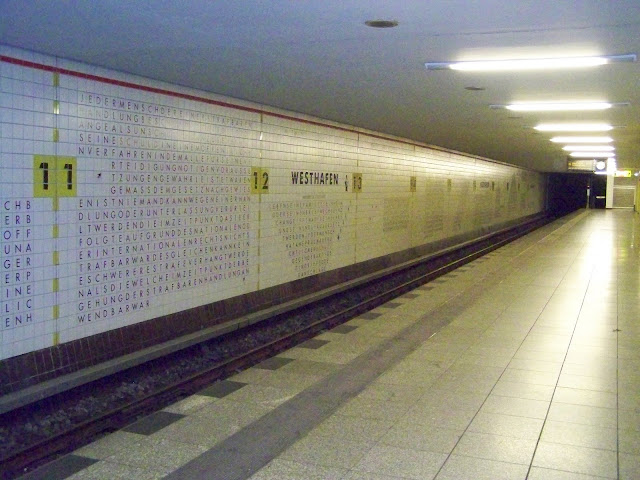
Another station i describe for this posting is the westhafen . The walls of this were inscribed with scrabble boards or the word seeker kind of letters. Artist project. Certainly a kind of neat graffiti. And there was an interesting inscription on the wall that I photographed. I will let the pictures speak. Notice the eyes, the birds and the human figures. The outside corridors had names of movies maybe but there was French line and it said “tout les monde"or something. This was a post-modern station so the exit opened bang on top of a flyover road that ran over both the Ubahn and the Sbahn stations, all layered like many meanings on an old word. There was no signboard or any welcome or whatsoever, just the pavement, empty foot path and the road!




Hope this will keep my readers happy for sometime, so next blog we travel the sbahn to the peacock Island, the pfauninsel!
“ eienstien bitte”( Halt for a minute? ) says the mechanical male voice in the train at the station. And as the train is about to leave, “ turwitsoplaz bitte” or something that means- train leaving or stand away from the door! Interestingly the Bus has a female voice calling out every stop. I love the way she calls out “lindenhaller alle” or “am rohr garten.”
 Most of U3 runs above ground in the first few stops. The first interesting train stop I describe is ONKEL TOM’S HUTTE. You guessed it, it is Uncle Tom’s hut! Most of hut station has interesting that shop-windows line both the train platforms. This is one of the stations where there is no wall opposite to the track as the train gently goes a few feet below road level (more in a train gutter than underground route). There is a Chinese take away, a cosmetic store, the ever welcome Aldi’s supermarket and a camera shop. Also a travel agent and many other small businesses like a florist and a electric lights showroom. It’s like the wild west main street we see in movies- with a few shops and one main road. The added attraction is a sparkasee atm from which we can draw money (when we have it in the account).
 Moving along U3 towards the university stops we see green grassy slopes on both sides and interesting graffiti on retaining walls which I can never photograph. As every glass window of the Ubahn, for decorative pride, has the famous stencil outline of the Brandenburger gate painted in white many times on it. Like a silly wall paper or a tee shirt pattern. Some gates stencils are upside down, looking like strange dead insects with the legs thrown up or with the columns pointing to the sides like many EEE or Mirrors of E or standing normal like the sticky elephants we drew with many legs). So in any photo, there will be graffiti on graffiti of the photograph which is too much even for a philosopher. Wall as text. Text on wall as a text. Window as text for text on wall. Brandenburger stencil as text on window as text for text on wall. My photo of “Window as text for text on wall along with Brandenburger stencil as text on window as text for text on wall” as text…. You get the drift?
At Dalem Dorf and Thielplatz, most people who get on and off are students and so expect a crowd. The university is sprawled out between the two stops you can climb out at Dalem and find yourselves walking through campus and suddenly Theil platz is closer. Interesting to note that all these stations get deeper, so by now it’s one floor below the road. The U-bahn starts to go underground. And every station has a glass lift that you enter through the one door and exit through the opposite. No maneuvers of reversing your pram or shopping trolley. Oh! this trolley must be written about. Many elderly people (and also other shoppers) carry a trolley with long stiff bag and trundle along their shopping like prams or airport cabin baggage. Very useful I thought!
Back to the station. The intersections begin after that you have to change lines to other Ubahns or to S Bahns and to get to the Charlottenburg area you climb out at fer-berliner platz. Most stations are uniquely designed. In the earlier tour, the lady had told us that they were colour coded but even otherwise they look nice and the pillars and the walls are different with photographs or some artwork or as usual, advertisements.
Charlottenburg has a schloss ( german word for castle/ fort/palace) but more interestingly it has some good shops for cheap clothes and Asian markets selling good Chinese and thai stuff. Check out German Woolworth’s and the local C & A and H & M if you are only if you are desperately looking for cheap winter wraps. Otherwise just wait till you get home to Chickpet or Sarojini market Delhi. We reached the schloss on a late Sunday evening and it was gloomy and locked. Just as we turned away disappointed, M shouted “ look at the lights, they are turning them on.” And soon enough we saw the timed lights switch on and slowly, sequentially light up the Schloss from the bottom to the angel on top and then go off slowly one by one. Very nice but what was the point? Anyway we photographed it along with the dozen other people who were busy with tripods and perfect pictures of the light ( gimme Mysore palace lights or the musical fountain anyday). I give this schloss an A for effort, B for the hype and C for architecture!


You walk out of the zoo-station at night and see the famous church with the bell tower that was damaged in the war.The Protestant Kaiser William Memorial Church (in German: Kaiser-Wilhelm-Gedächtniskirche) in the centre of the Breitscheidplatz. The original church on the site was built in the 1890s. It was badly damaged in a bombing raid in 1943. The damaged spire of the old church has been retained and its ground floor has been made into a memorial hall. It’s reconstructed with blue stained glass and looks beautiful. Its said to be made of a concrete honeycomb containing 21,292 stained glass inlays. The glass, designed by Gabriel Loire, was inspired by the colours of the glass in Chartres Cathedral.
 The central paved courtyard is beautiful and has the cleanest WC, I have ever seen. Steel and glamour with the treads on the steps- so you cannot slip. For 50 cents that I paid to use it, I got to see a sensor flush in operation! Also prominent is the Benz logo on a tall building and lights arcing out around in like search lights. They seem to say “who dares challenge the merc, we will searchlight you out!” the church, the merc and the blue glass wall were more interesting light display than the C. Schloss.

Another station i describe for this posting is the westhafen . The walls of this were inscribed with scrabble boards or the word seeker kind of letters. Artist project. Certainly a kind of neat graffiti. And there was an interesting inscription on the wall that I photographed. I will let the pictures speak. Notice the eyes, the birds and the human figures. The outside corridors had names of movies maybe but there was French line and it said “tout les monde"or something. This was a post-modern station so the exit opened bang on top of a flyover road that ran over both the Ubahn and the Sbahn stations, all layered like many meanings on an old word. There was no signboard or any welcome or whatsoever, just the pavement, empty foot path and the road!


Hope this will keep my readers happy for sometime, so next blog we travel the sbahn to the peacock Island, the pfauninsel!
Subscribe to:
Posts (Atom)